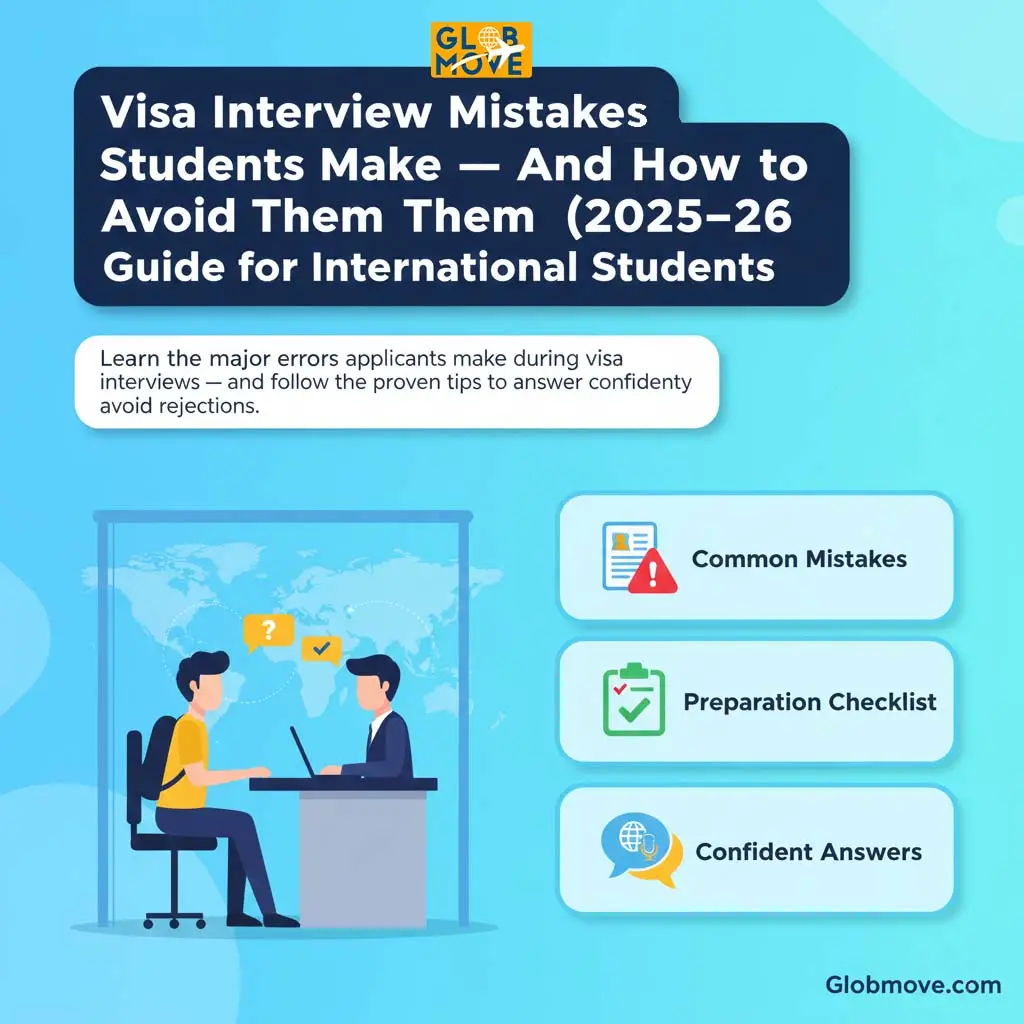
Visa Interview Mistakes Students Make — And How to Avoid Them (2025-26 Guide for International Students)
As an international student that seek to pursue higher education abroad you will go through long process from admission to scholarship. But most of the times that’s not the end of the process as there is one crucial step which is decisive in determining whether or not you will move to study abroad and that is a visa interview. It is crucial and most nerve-racking step before beginning their study journey abroad. You’ve done the research, prepared properly, chosen your course, secured your admission, prepared your documents and now one conversation with a visa officer at the embassy becomes decisive. One thing you have to recognize is that it is not there to scare you but it is there to verify your intentions, confirm your readiness in different ways, and ensure you understand your program. But as you know number of students fail on this step not because they lack academic ability or not capable of it but because they make costly mistakes during the interview.
In this, I will explain the most repeated mistakes during the visa interview of studying abroad to inform you reasons and ensure that you will avoid them when it’s your time to conduct interview. It doesn’t matter If you’re applying to countries like the USA, UK, Canada, Germany, France, Australia, Italy, Netherlands, or Korea as these information will help you approach your interview correctly and increase your chances of approval with the relevant information.
1. Not Understanding Your Course or University
This is one of most costly mistake you could possibly make as it simply is extremely important to know properly. This happens as Students cannot explain why they chose their course or university by giving proper reasons of pursuing that education.
Visa officers need to know that you have a clear academic plan. You have to avoid the following answers as they show lack of commitment and plan and some of these answers are:
- “I just applied because someone told me.”
- “I don’t really know much about the course details.”
- “The university looked good and I liked that.”
- “I just want to go abroad and move out.”
✔ What to do instead
Instead of the answers above you should explain clearly:
- Why you chose the course you have chosen
- What subjects you will study
- How it connects to your previous education
- Why this country is ideal for your field you have chosen
- What career path it leads to and how it helps with it
2. Not Knowing Your Financial Plan
Financial aspect of an individual is one of the most crucial aspect in this process and it matters the most which explains why it’s reason of rejection for number of people.
You have to properly explain:
- Who is funding your studies when you pursue your education
- Their income source which could be your parents
- How many dependents your sponsor has and their
- Proof of savings that is showed officially
- Tuition and other living cost breakdown as it determines income and saving needed
There might be scholarship but if it’s partial or no scholarship, then this need a serious attention as the officer may believe you cannot afford the program.
✔ What to do
Prepare a clear financial explanation, such as:
- Clearly demonstrate that My father or someone is sponsoring me
- State He earns this amount and other explanation
- Provide Information about saving by stating that we have savings of $____ for tuition
- Additional funding from if there is one
- Explain Living costs estimated and how it will be covered
3. Giving Overly Long or Unnecessary Answers
This is also another problem as many applicants talk too much due to stress.
Example:
Officer: Why do you want to study in Canada?
Student: talks for 4 minutes about unrelated topics that are not going to be helpful in contributing to showing plan and goals.
This might raises suspicion and might result in unfavourable consequence.
✔ What to do instead
Use this structure:
Reason + Evidence + Goal
Example: you should be precise, clear and respond the real answer as they prefer that instead of above mistake. “I chose Canada because the program offers practical experience, strong industry links, and aligns with my career goal of becoming a data analyst.”
4. Appearing Nervous, Rigid, or Scared
As you might or might not know they understand and trained to observe body language. If you seem:
- Too afraid
- Too stiff
- Too anxious
- Too defensive
This may look like you are hiding something or have a different reason other than academic goal which could result in bad outcome combined with other reasons.
✔ What to do instead
Address calmly and do not overthink about being perfect but you should be authentic and intentional while providing proper answers.
- Breathe normally
- Sit straight
- Make eye contact and be clear
- Smile politely but not too much as it might seem nervousness
- Treat the interview like a normal conversation instead of too much pressure
5. Giving Inconsistent Information
This is the prominent reason for rejections for many and obviously it’s very costly.
Examples:
- Different financial statements or highly inaccurate
- Wrong tuition fee numbers or other financial information
- Different sponsor explanation that’s improper
- Conflicting answers about living arrangements
Visa officers instantly notice inconsistencies as they are there to identify these and be very careful about these one as well.
✔ What to do instead
Review all your details:
- CAS / LOA
- Tuition fees you are expected to pay
- Program details
- Financial documents you provide
- Sponsor’s income
6. Speaking English Unnaturally
As some of you might have done, most people watch and read the so called best answers and memorize them when they actually do not need to and that can be detected while sounding fake. They can easily recognize this and immediately realize this is all scripted as it involves unusual answers that sounds as if it’s very smart but no student actually speak like that.
✔ What to do instead
- Speak naturally.
- Your English doesn’t need to be perfect but you anwers needs to be authentic and planned.
- Use SIMPLE sentences:
- “I chose this course because it helps me build skills in this and that.”
- “I want to return home to work in something you want to.”
7. Mentioning Intentions to Stay Forever
This could easily be quick rejection as most of the time the scholarship or study programs insist the student return to their home country to work and apply knowledge. But some make this error by answering the likes of following:
- “I want to work and live there forever.”
- “I want to bring my family to move there.”
- “I want permanent residency immediately.”
This shows that you are using it for immigration purpose and not for pursuing educational goal which result in rejection of your visa.
✔ What to do instead
- Focus on studies + career goals.
- You can mention returning home to use your skills and apply your knowlege.
- Example:
- “After completing my studies, I plan to return and work in this and that, where demand for this field is growing.”
8. Over-reliance on Agents
Another famous mistake that students make is being heavily dependent on agent while they could do it in their own and this might be costly or rejection when:
- Agents fill incorrect information which could be personal or educational
- Students don’t understand what was submitted
- Agents prepare scripted answers that they memorize
- Students rely on memorization instead of research and plan
✔ What to do instead
- Read your admission letter and prepare
- Understand your program and relevant details
- Know your financial documents and information properly
- Practice speaking naturally and clearly so that you don’t memorize that or sound like
9. Not Knowing Post-Study Plans
Related to one above it is crucial to state plan and Visa officers often ask: “What are your plans after graduation?”
If you hesitate or answer weakly, it could shows that you lack plan or have a different inappropriate plan i.e just migration.
✔ What to do instead Give a realistic plan:
- A job role you seek after study
- A sector
- Your home country’s demand and why that
- How the program will help you with all
Example:
“My country is expanding its renewable energy sector. This degree prepares me to work as a sustainability engineer’’
10. Not Dressing Properly
It also matter as it could reflect professionalism and commitment and it Is conducted in professional setting.
✔ What to do instead
Wear simple, clean clothes such as:
- Shirt and trousers or smart casual as they say
- Professional top
- Formal dress if you prefer and do not use caps, sunglasses and other flashy stuff
Most Common Visa Interview Questions (and How to Answer Them)
- Why did you choose this country?
Answer must include:
- Education quality and utilize information regarding country’s education
- Specific aspects that make it great for you
- Connection to your field
- Why this university?
Here you could reflect properly as you might have done a research and might have something to talk about which could be programs, professors, ranking, or facilities.
- How will you fund your studies?
Clearly provide full information while avoiding the mistakes above. State sponsor clearly and financial proof.
- What are your plans after graduation?
Just like suggested above Say:“My goal is to return and work in this sector.”
- Do you have relatives in this country?
Be authentic and answer honestly as they check your visa history.
- What do you know about your course?
Mention:
- Modules or info relevant
- Duration of studying your program
- Skills you’ll learn by studying Why should we approve your visa?
Focus on:
- Genuine study intention and academic plan
- Clear goals that the study will help you with
- Strong financial information
Conclusion
In conclusion, Visa interviews are stressful for several reasons but it doesn’t have to be considered extremely complicated as it is easily doable with proper preparation regarding knowledge of the field, genuine financial proof, clear academic plan and effective communication of answers properly. In addition you should also understand common mistakes and preparing clear, natural answers, you can confidently present yourself as a genuine student with a real purpose which could result in favourable outcome for you to move to a country of your dream while studying you choice of program.