Fully Funded Joint Master’s Programs in Europe – How to Apply, Benefits & Official Catalogue
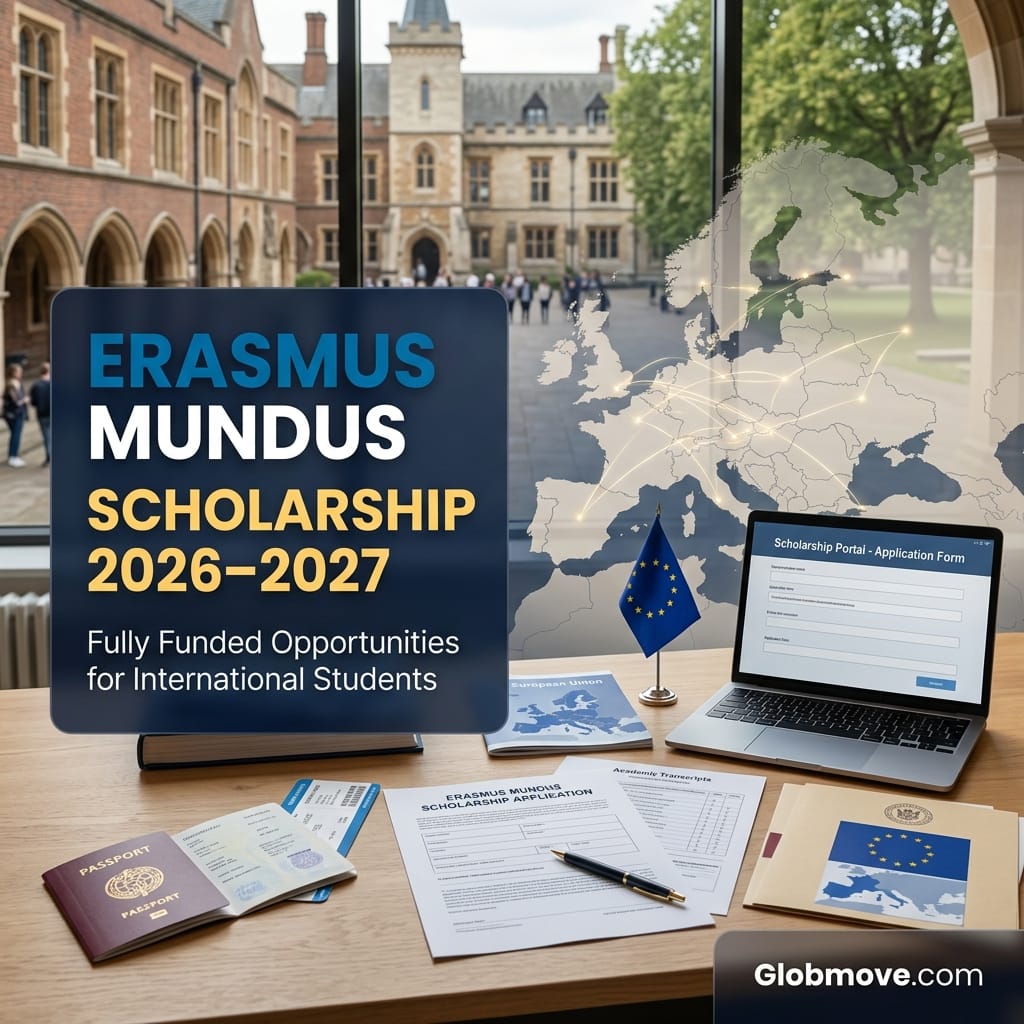
The Erasmus Mundus Joint Masters (EMJM) scholarship is one of the most prestigious fully funded opportunities for international students to study in Europe. Funded by the European Union under the Erasmus+ program, it allows selected students to complete a high-quality master’s degree while studying in at least two different countries.
Applications for many programs that start in autumn 2027 are opening in autumn 2026. This guide explains exactly how the scholarship works, what it covers, who can apply, and the practical steps to maximise your chances of selection.
What Is the Erasmus Mundus Scholarship?
Erasmus Mundus Joint Masters are integrated international master’s programs delivered by consortia of universities from different countries. Successful scholarship holders study in multiple European (and sometimes partner) countries, earn a joint or multiple degree, and receive full financial support.
The European Commission selected 37 new Joint Master programs in 2026. Student applications for these and many continuing programs open during autumn 2026, with the first cohorts starting in September 2027.
Scholarship Benefits – Fully Funded Package
Selected students typically receive:
- Full tuition fee waiver for the entire program
- Monthly living allowance of approximately €1,400
- Contribution to travel costs (amount depends on distance from home country)
- Installation contribution (one-time)
- Comprehensive health and accident insurance
The exact package is confirmed by each consortium, but the scholarship is designed so that students can focus fully on their studies without major financial pressure.
Program Duration and Structure
Most Erasmus Mundus programs last 12, 18 or 24 months (60, 90 or 120 ECTS). Students usually spend time at two or more partner universities in different countries. The joint nature of the degree is one of the strongest features of the scheme.
Who Can Apply? Eligibility Overview
General requirements (individual programs may add extra conditions):
- Hold a bachelor’s degree (or equivalent) or be in the final year and able to graduate before the program starts
- Be from any country in the world (both EU and non-EU students are eligible)
- Not have previously received an Erasmus Mundus Joint Master scholarship
- Meet the specific academic and language requirements of the chosen program
Language requirements vary. Many programs accept IELTS, TOEFL, or equivalent English tests; some accept certificates from previous English-taught degrees. Always check the program website.
Here are two extra relevant sections (each ~350 words) you can insert into the Erasmus Mundus article to increase length and target more keywords:
Best Erasmus Mundus Programs for 2026–2027 Applicants
Choosing the right Erasmus Mundus Joint Master is one of the most important decisions for international students aiming for a fully funded master’s in Europe. With more than 200 programs currently listed in the official catalogue and 37 newly selected programs opening applications in autumn 2026, the competition is high but the opportunities are wider than ever.
Popular and highly competitive fields for the 2026–2027 cycle include Data Science and Artificial Intelligence, Environmental Science and Sustainability, Public Policy, International Relations, Engineering (especially renewable energy and semiconductor technologies), Health Sciences, and Business Innovation. Many new programs focus on cutting-edge areas such as Medical Image Analysis, Semiconductor Technologies, Water Engineering, Nuclear Decommissioning, and Law & Data AI.
When selecting programs, prioritize those that match your bachelor’s degree background closely. Consortia look for academic coherence. Also check the mobility track carefully — some programs require study in three or four countries, while others offer more flexibility. Language of instruction is usually English, but a few programs include courses in the local language of partner universities.
Students from developing countries often have slightly higher chances in programs that reserve additional scholarships for specific regions. Always read the “Target Groups” or “Scholarship Allocation” section on each program website. Applying to three carefully chosen programs (the maximum allowed by most consortia) is a smart strategy rather than applying randomly to many.
Start shortlisting programs now using the official Erasmus Mundus Catalogue. Filter by subject, check the application deadlines one by one, and prepare tailored motivation letters for each. Early preparation significantly improves selection chances for the highly competitive Erasmus Mundus scholarships 2026–2027.
When Do Applications Open?
There is no single central deadline. Each consortium sets its own timeline. In practice:
- Most applications open between October and January
- Deadlines usually fall between November and January for programs starting the following September
- Some programs have earlier or later windows
Because you can apply to a limited number of programs (often up to three), it is essential to track individual deadlines carefully.
How to Apply – Step-by-Step Strategy
- Visit the official Erasmus Mundus Catalogue and search by subject area.
- Shortlist 2–4 programs that match your academic background and career goals.
- Go to each program’s official website (do not rely only on the catalogue summary).
- Read the eligibility criteria, language requirements, required documents, and exact deadline.
- Prepare strong application materials: academic transcripts, CV (Europass format is often preferred), motivation letter, recommendation letters, proof of language proficiency, and passport copy.
- Submit the online application directly through the program portal before the deadline and tick the scholarship option.
- Track results and respond quickly if additional documents are requested.
How Competitive Is Erasmus Mundus and How to Stand Out in 2026
The Erasmus Mundus scholarship is highly competitive. Most programs receive hundreds or even thousands of applications for a limited number of fully funded places (usually 15–25 scholarships per intake).
Key factors that determine selection:
- Academic excellence (strong GPA or class ranking)
- Clear and personal motivation letter tailored to the specific program
- Relevant internships, research, projects, or work experience
- Strong recommendation letters from professors or supervisors
- Overall fit with the program and mobility track
How to stand out in the 2026 cycle:
- Write a motivation letter that clearly explains why this specific consortium and study path match your goals
- Avoid generic letters — they are easily rejected
- Highlight any international or cross-cultural experience
- Make sure your language certificate is valid and meets the exact score required (IELTS 6.5–7.0 is common) Prepare all documents at least one month before the earliest deadline Practical advice:
- Track deadlines carefully (most close between November and January)
- Apply to a maximum of three well-chosen programmes
- Treat the application like a professional project: research, tailor, proofread, and submit early
Documents Commonly Required
- Online application form
- Bachelor’s degree certificate and full transcripts (with official translation if needed)
- Curriculum Vitae (preferably Europass)
- Motivation letter / statement of purpose
- Two or three recommendation letters
- Proof of English (or other required language) proficiency
- Copy of passport
- Any additional documents specified by the consortium (portfolio, research proposal, etc.)
Tips to Strengthen Your Application
- Start research early — the strongest candidates prepare documents months in advance.
- Tailor your motivation letter to each specific program and consortium.
- Highlight international experience, academic excellence, relevant projects, and clear career goals.
- Choose programs that genuinely match your profile rather than applying randomly.
- Obtain strong recommendation letters from professors or employers who know your work well.
- Check whether the program accepts applications without the scholarship (self-funded places) as a backup option.
Common Mistakes to Avoid
- Missing individual program deadlines because you assumed there was one central date.
- Submitting a generic motivation letter that does not mention the specific consortium or mobility path.
- Applying to programs outside your academic background.
- Uploading incomplete or poorly scanned documents.
- Ignoring language requirements or submitting expired test scores.
- Waiting until the last week to start the application.
Related Opportunities on Globmove
If you are exploring other fully funded pathways, these guides may also help:
How to Apply Erasmus Mundus Scholarship 2025
Australian Awards Scholarship 2026 Fully Funded
China CSC Scholarship 2026 ZJNU
Swedish Institute Scholarships SISGP 2026
Final Thoughts
The Erasmus Mundus scholarship remains one of the strongest fully funded routes into European higher education. Success depends on careful program selection, early preparation of documents, and a clear, well written motivation that shows why you are a good fit for the specific consortium.
Because each program runs its own. selection, always verify the latest requirements and deadlines on the official programme website.