
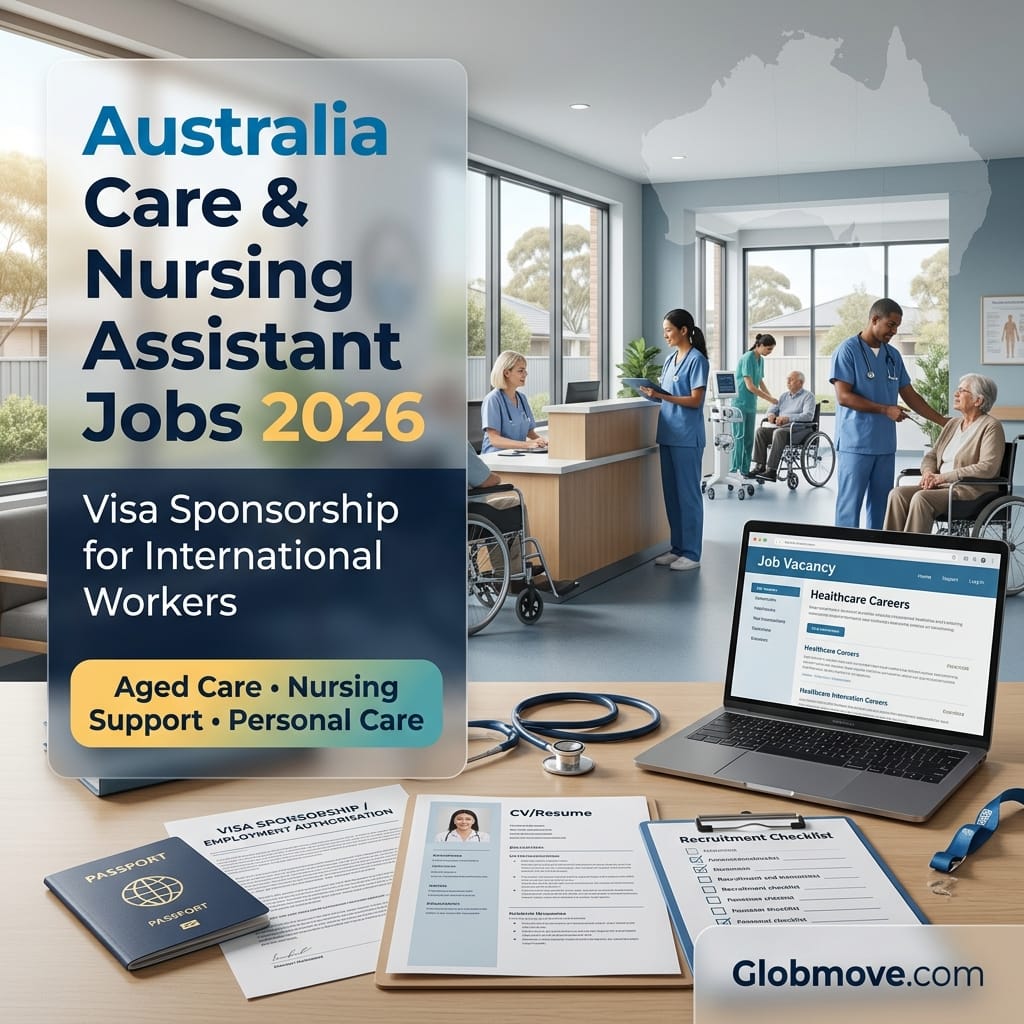
Complete Guide to Aged Care Worker Pathways, ACILA Sponsorship & Permanent Residency Options
Australia continues to face a significant shortage of direct care workers in residential aged care and home care settings. For international job seekers, this creates a realistic pathway into the country through employer sponsored visas — particularly under the Aged Care Industry Labor Agreement (ACILA).
This guide explains exactly how care and nursing assistant roles work for visa sponsorship in 2026, which occupations are covered, the salary and English concessions available, and how to position yourself as a strong candidate. It also covers the clear route from temporary sponsorship to permanent residency.
Why Australia Is Hiring Care and Nursing Assistants in 2026
The aged care sector remains one of the highest-demand areas in Australia’s labor market. An ageing population, expanded home-care packages, and ongoing workforce shortages mean approved providers actively look for overseas workers when local recruitment falls short.
Unlike many skilled migration streams that require high salaries or long professional experience, the dedicated aged care pathway offers meaningful concessions on salary, English language, and work experience. This makes it one of the more accessible visa-sponsorship routes for workers with Certificate III-level qualifications or equivalent practical experience.
Key Occupations Eligible for Visa Sponsorship
Under the Aged Care Industry Labour Agreement, three direct-care occupations are specifically covered:
Occupation | ANZSCO Code | Skills Assessing Authority |
Aged or Disabled Carer | 423111 | Community Work Australia (ACWA) |
Nursing Support Worker | 423312 | ANMAC |
Personal Care Assistant | 423313 | ANMAC |
These roles involve providing personal care, assisting with daily living activities, supporting mobility, and working under the direction of registered or enrolled nurses. They are distinct from Registered Nurse positions, which follow different registration and visa pathways through AHPRA.
How Visa Sponsorship Works: The ACILA Pathway
The primary route for most care and nursing assistant roles is the Aged Care Industry Labor Agreement (ACILA). This is an industry-wide labor agreement that allows approved aged care providers to sponsor overseas workers on the Skills in Demand (subclass 482) visa, with a pathway to permanent residency under the Employer Nomination Scheme (subclass 186).
Main Concessions Under ACILA
- Salary threshold: approximately AUD 51,222 guaranteed annual earnings or the Australian Market Salary Rate (whichever is higher) — significantly lower than the standard Core Skills Income Threshold.
- English language: IELTS 5.0 overall (with Listening and Speaking at 5.0 and Reading/Writing at 4.5 for standard providers). Further concessions may apply for culturally and linguistically diverse (CALD) providers.
- Work experience: No post-qualification experience required for the subclass 482 visa if you hold a relevant Certificate III or equivalent.
- Pathway to permanent residency: After two years of full-time work in a relevant direct-care role in Australia, you can be nominated for the subclass 186 visa.
Important Notes
- The employer must hold an approved ACILA (or another relevant labour agreement) and usually a Memorandum of Understanding with a relevant union.
- You cannot apply for the visa independently — the employer nominates you.
- Disability sector employers generally cannot use ACILA and must look at Designated Area Migration Agreements (DAMAs) instead.
Qualification and Skills Assessment Requirements
To be competitive and meet sponsorship requirements, most applicants need:
- A Certificate III in Individual Support (Ageing) or an equivalent overseas qualification.
- A positive skills assessment — from ANMAC for Nursing Support Worker and Personal Care Assistant roles, or from Community Work Australia (ACWA) for Aged or Disabled Career roles.
- Relevant practical experience is highly valued even when not strictly required for the 482 visa.
If you already have overseas qualifications or substantial experience, many applicants use Recognition of Prior Learning (RPL) pathways to obtain the Australian Certificate III. Completing the Certificate III in Australia (often around six months) is another common route for international students or temporary residents.
Typical Salary Expectations
Salaries vary by location, shift patterns, and whether the role is residential or home care. Under ACILA the minimum guaranteed earnings sit around AUD 51,222, but many providers pay higher market rates, especially with overtime, weekend, and night-shift penalties.
Actual take-home pay depends on hours worked and enterprise agreements. Regional areas may offer additional incentives or lower living costs.
How to Find Sponsoring Employers
There is no single public register of every ACILA-approved provider that is easy to search. Practical approaches include:
- Search major job boards (Seek, Indeed, LinkedIn) using keywords such as “aged care visa sponsorship”, “personal care assistant sponsorship”, or “nursing support worker 482”.
- Target large national providers that have sponsored in the past (examples include Opal HealthCare, Bupa Aged Care, Regis Aged Care, Estia Health, and various state-based not-for-profits). Always verify current sponsorship willingness in the job advertisement or by direct enquiry.
- Explore regional opportunities through Designated Area Migration Agreements (DAMAs) in areas such as the Northern Territory, South Australia, and parts of Western Sydney and other designated regions.
- Prepare a clear CV that highlights Certificate III (or equivalent), any aged-care or disability support experience, English test results, and willingness to relocate.
Documents to Prepare Before Applying
- Updated CV tailored to care roles (highlight hands-on experience and soft skills).
- Passport (valid for the required period).
- Educational certificates and transcripts (Certificate III or overseas equivalent).
- Skills assessment outcome letter (ANMAC or ACWA) when required.
- English language test results (IELTS, PTE, or equivalent) meeting the agreement threshold.
- Employment references or evidence of relevant work experience.
- Any Australian police check or capacity to obtain one quickly if requested.
Tips for a Strong Application
- Tailor every application to the specific provider and role — generic CVs are easy to ignore.
- Emphasis reliability, empathy, physical fitness for care duties, and any experience with dementia or complex care needs.
- Show genuine interest in staying long-term; employers invest significant time and cost in sponsorship.
- Be realistic about location — many opportunities are outside major capital cities.
- Check that the employer is actually approved to sponsor under ACILA or a relevant DAMA before investing heavy effort.
- Keep copies of all correspondence and documents organized.
Common Mistakes to Avoid
- Assuming every aged-care job advertisement offers visa sponsorship.
- Applying without a relevant Certificate III or clear plan to obtain one.
- Underestimating English requirements or submitting outdated test results.
- Ignoring the difference between ACILA (aged care) and standard 482 pathways used by Registered Nurses.
- Paying recruitment agents large upfront fees — legitimate employers cover sponsorship costs and do not charge workers for the visa nomination.
- Relying only on one job board; combine multiple sources and direct approaches.
Pathway to Permanent Residency
One of the strongest features of the ACILA route is the relatively clear path to permanent residency. After completing two years of full-time work in a relevant direct-care occupation in Australia, an eligible employer can nominate you for the subclass 186 visa under the Temporary Residence Transition stream. Age limits and other standard ENS requirements still apply, so plan ahead.
Related Opportunities on Globmove
If you are exploring other visa-sponsorship pathways, these guides may also help:
Find Visa Sponsorship Jobs in Australia Using Seek 2026
Work in Germany with Visa Sponsorship 2026
Global Jobs with Visa SponsorshipWork in Luxembourg 2026
Final Thoughts
Care and nursing assistant roles under the Aged Care Industry Labour Agreement represent one of the more realistic employer-sponsored pathways into Australia for workers with the right qualifications and attitude. Success depends on matching your profile to genuine shortages, preparing complete documentation, and targeting employers who are already set up to sponsor.
Always verify current requirements on the Department of Home Affairs website and confirm details directly with any potential employer. Conditions, salary thresholds, and occupation coverage can be updated, so treat this guide as a practical starting point rather than the final authority.