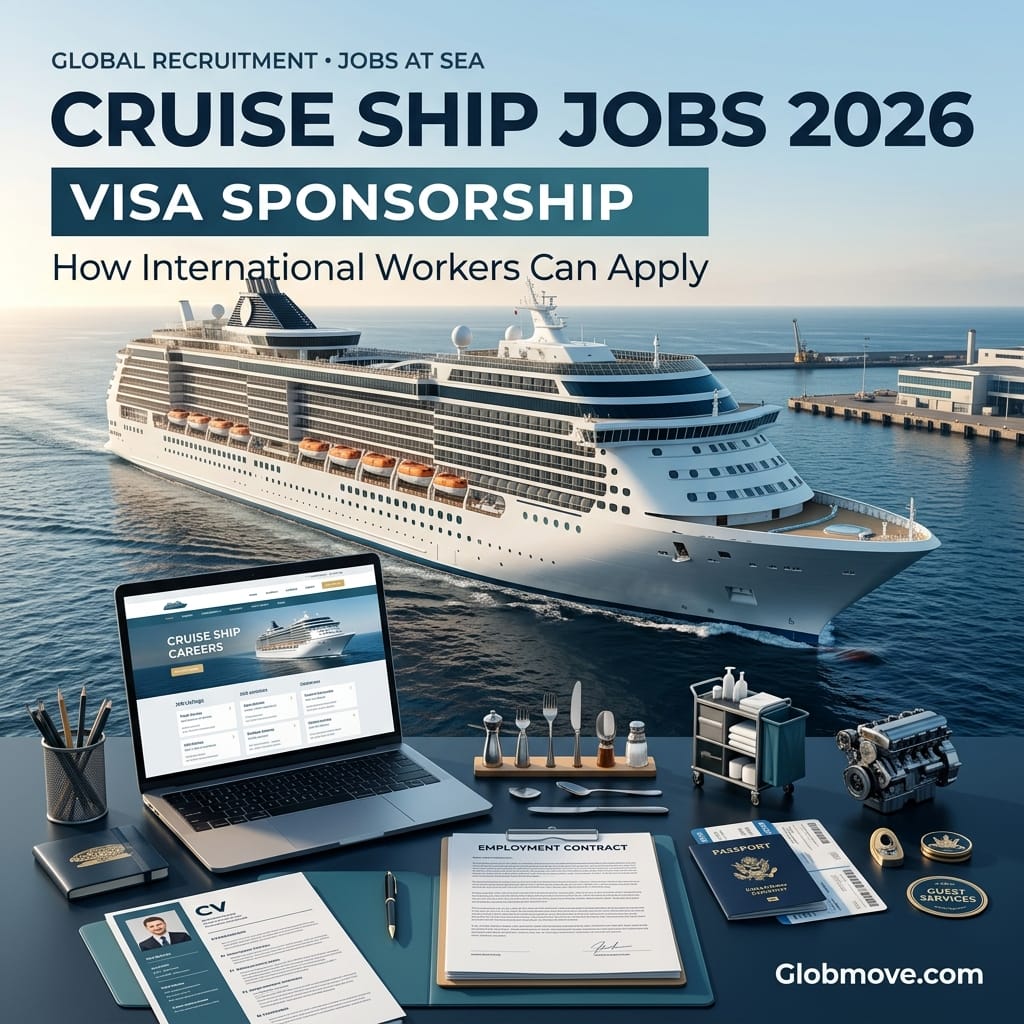
Cruise Ship Jobs With Visa Sponsorship 2026: How International Workers Can Apply
Working on a cruise ship is one of the more unusual ways to find international employment because the job itself is not tied to one permanent country. Crew members may live onboard a vessel, travel between several countries, and work for an international cruise company while being recruited from their home country.
That makes cruise ship jobs with visa sponsorship particularly attractive to people who want to work abroad but do not yet have a conventional employment visa for countries such as the United States, Canada, or European countries.
However, cruise employment is frequently misunderstood. A vacancy saying that international applicants are welcome does not mean the company will simply give you a visa and fly you overseas without further requirements. Cruise companies have formal recruitment, medical, security, maritime-documentation and immigration procedures.
For many non-US and non-Canadian crew members working on ships that visit or transit through the United States, a C1/D crew visa is an important part of the process. Royal Caribbean Group, Carnival Cruise Line, Princess Cruises and Norwegian Cruise Line all explain this requirement in their official recruitment information.
The opportunity is real, but understanding how the system works is what separates a genuine application from the many cruise-job scams circulating online.
Why Cruise Ship Jobs Are Attractive to International Workers
Cruise employment can provide something that ordinary overseas jobs often cannot: the ability to work internationally without first establishing permanent residence in the country where the ship is visiting.
A crew member may join a vessel in one country, spend several months working onboard, visit multiple destinations, and then return home at the end of an assignment.
Cruise companies also recruit for a surprisingly broad range of occupations.
Depending on the company and current vacancies, opportunities can include:
- Housekeeping and cabin attendants
- Restaurant and food-service positions
- Cooks and galley staff
- Bartenders
- Guest services
- Retail positions
- Entertainment
- Spa and wellness
- Photography
- Youth activities
- Deck and technical positions
- Marine engineering
- Medical roles
- Administrative and supervisory positions
This means cruise employment is not exclusively for experienced seafarers.
A person with hotel, restaurant, customer-service, housekeeping, retail or hospitality experience may have a more relevant profile for hotel operations onboard than someone with no practical experience at all.
Is Cruise Ship Employment Actually Visa Sponsorship?
This is where applicants need to use the terminology carefully.
Cruise companies generally do not advertise these jobs in exactly the same way as a conventional company advertising “visa sponsorship jobs in the USA.”
Instead, the company hires you for a shipboard position and then supports the documentation needed for you to join the vessel.
For example, Royal Caribbean says that non-US and non-Canadian workers must be able to obtain a C1-D visa, and the company provides a letter supporting the application when a candidate is offered a position.
Carnival similarly states that its onboarding process includes obtaining necessary travel documents and visas, including C1/D visas for non-American and non-Canadian applicants.
Therefore, when people search for cruise ship jobs with visa sponsorship, what they often really want is an international cruise employer that hires foreign workers and assists them with the documentation needed to legally join the vessel.
That is a legitimate employment pathway, but it should not be confused with permanent immigration sponsorship.
What Is the C1/D Visa?
The C1/D visa is a US combination transit and crew visa used by eligible foreign crew members who need to travel through or join vessels involving the United States.
Royal Caribbean explains that the C1/D is issued by US embassies and allows crew members to transit through US ports. If a candidate is offered a position, Royal Caribbean provides a supporting employment letter.
Princess Cruises also describes the C1/D as a seaman’s visa and states that most non-US and non-Canadian crew members need one for shipboard employment.
This distinction is important because applicants sometimes see “US visa” in cruise recruitment advertisements and assume they are receiving permission to live and work permanently in the United States.
They are not.
The C1/D is connected to crew employment and maritime travel. It is not a pathway that automatically gives the holder permanent residence or unrestricted employment in the United States.
Who Can Apply for Cruise Ship Jobs?
The exact requirements vary considerably according to the position.
A hotel department position may have completely different requirements from a marine engineering role.
For many entry-level and hospitality positions, employers may look for:
- Previous hotel, restaurant or customer-service experience
- Good spoken English
- Professional appearance
- Ability to work in a multicultural team
- Flexibility with working hours
- Strong customer-service skills
- Ability to remain calm under pressure
Marine and technical positions can have much stricter requirements, including maritime qualifications, certifications and documented sea experience.
Princess Cruises states that some deck and technical positions require a Seaman’s Book and STCW certification, while these are generally not required for many hotel positions.
This is why applicants should never assume that one set of requirements applies to every cruise job.
Cruise Ship Jobs for People Without Maritime Experience
One of the most useful things to understand is that cruise ships are floating businesses, not simply transportation vessels.
A large cruise ship needs people to operate restaurants, hotels, entertainment venues, shops, housekeeping departments and guest services.
That creates opportunities for people whose professional background is not maritime.
For example, someone who has worked in a hotel can target housekeeping or guest-service roles.
A restaurant worker could consider food and beverage positions.
A retail employee may be better suited to onboard retail.
A customer-service professional could target guest relations.
This is generally a much more realistic strategy than applying for deck or engineering positions without maritime qualifications.
What Are the Benefits?
Despite the demanding lifestyle, cruise employment can provide several attractive benefits.
Depending on the employer and contract, crew members may receive accommodation onboard and meals as part of their employment arrangement.
Some companies also arrange transportation to and from the vessel.
Norwegian Cruise Line says that for most assignments it provides transportation from the employee’s home to the ship and back for the full assignment period.
Princess Cruises similarly states that it provides flights from the designated airport to the assigned ship at the beginning of an assignment and arranges return travel at the end of the contract.
However, benefits vary according to the employer, position and contract.
Never assume that an expense is covered simply because another cruise line provides that benefit.
What Documents Are Normally Required?
The paperwork depends on the role and cruise company, but international crew members should expect a serious onboarding process.
Potential requirements include:
- Valid passport
- Employment documentation
- C1/D visa where applicable
- Medical fitness examination
- Police or criminal background clearance
- Relevant professional certificates
- Seaman’s Book for applicable roles
- STCW certification for applicable maritime positions
- Additional visas required by the ship’s itinerary
Royal Caribbean lists a valid passport, C1-D eligibility, medical examination, relevant itinerary visas, qualifications, background checks and other documentation among its shipboard requirements.
This is one reason a genuine cruise recruitment process may take considerably longer than applicants expect.
How the Application Process Usually Works
Although individual companies use different systems, the process generally follows a pattern.
1. Find a Suitable Vacancy
Start with the official career site of the cruise company or an authorized recruitment partner.
Do not begin by sending money to a social media recruiter.
2. Submit Your CV
The company reviews your education, employment history, skills and qualifications.
Carnival’s official process asks candidates to provide information about education and work experience and may request resumes, cover letters and certified professional qualifications.
3. Complete an Interview
Depending on the role, interviews can be conducted online, by video, or through other recruitment channels.
Princess says candidates who pass the initial review may be invited to an interview with a professional recruiter, with some positions requiring additional interviews.
4. Receive a Provisional or Formal Offer
Successful candidates move into the employment and onboarding stage.
5. Complete Medical and Background Requirements
A medical fitness assessment and police/background checks are commonly required.
6. Obtain Necessary Travel Documents
If you are a foreign national who requires a C1/D visa, the company or recruitment team provides instructions and supporting documentation.
7. Receive Your Assignment
Your employment is not necessarily complete simply because you have passed the interview.
Carnival states that employment is confirmed once the onboarding steps are completed and the contract for the first shipboard assignment is accepted. (Carnival Careers)
How to Avoid Cruise Job Scams
This may be the most important part of the entire article.
Cruise employment attracts scammers because the jobs appear international, well-paid and accessible to people from developing countries.
Fraudsters may pretend to represent major cruise companies and send fake offer letters.
Norwegian Cruise Line specifically warns that fraudulent individuals have been sending fake job offers and requesting money or visa-related documents. The company says its hiring partners will never require candidates to pay an application, processing or agency fee as part of the employment application.
Royal Caribbean also maintains an official list of authorized hiring partners and warns applicants to use only those listed recruitment channels.
If somebody contacts you through WhatsApp or Facebook and says:
“Pay $2,000 and we will guarantee your cruise ship visa.”
Stop.
Verify the recruiter through the cruise company’s official careers website before providing documents or money.
How to Make Your CV Stronger for Cruise Jobs
Your CV should reflect the department you are targeting.
For hospitality positions, emphasize:
- Hotel experience
- Restaurant experience
- Customer service
- Food preparation
- Housekeeping
- Guest relations
For retail:
- Sales
- Customer service
- Cash handling
- Inventory
- Product knowledge For administrative roles:
- Office administration
- Data entry
- Communication
- Microsoft Office
- Documentation
- Customer support
For technical positions:
- Maritime qualifications
- Engineering experience
- STCW certification
- Seaman’s Book
- Equipment experience
Do not create one generic CV and send it to every department.
A recruiter should be able to understand your suitability within seconds.
Final Thoughts
Cruise ship jobs with visa sponsorship can be a legitimate route to international employment in 2026, particularly for people with hospitality, customer-service, food service, housekeeping, retail, entertainment, technical or maritime experience.
But the opportunity should be approached as a real job—not as a shortcut to immigration.
The most important thing to understand is that cruise companies recruit employees for specific shipboard positions and then guide successful candidates through the documentation required to join their vessels. For many foreign crew members, that includes a C1/D visa when US ports are involved.
The best strategy is therefore straightforward: identify your strongest department, apply through the official cruise company’s career system or an authorized hiring partner, prepare a targeted CV, perform well during interviews, complete medical and background requirements, and follow the company’s instructions for visas and travel.
Most importantly, never pay an unknown person for a guaranteed cruise job or visa. Official cruise companies actively warn applicants about fraudulent recruiters and fake employment offers.
For international workers who are willing to work hard, live onboard and spend several months away from home, cruise employment can provide valuable international experience and a practical way to enter the global hospitality and maritime employment market.