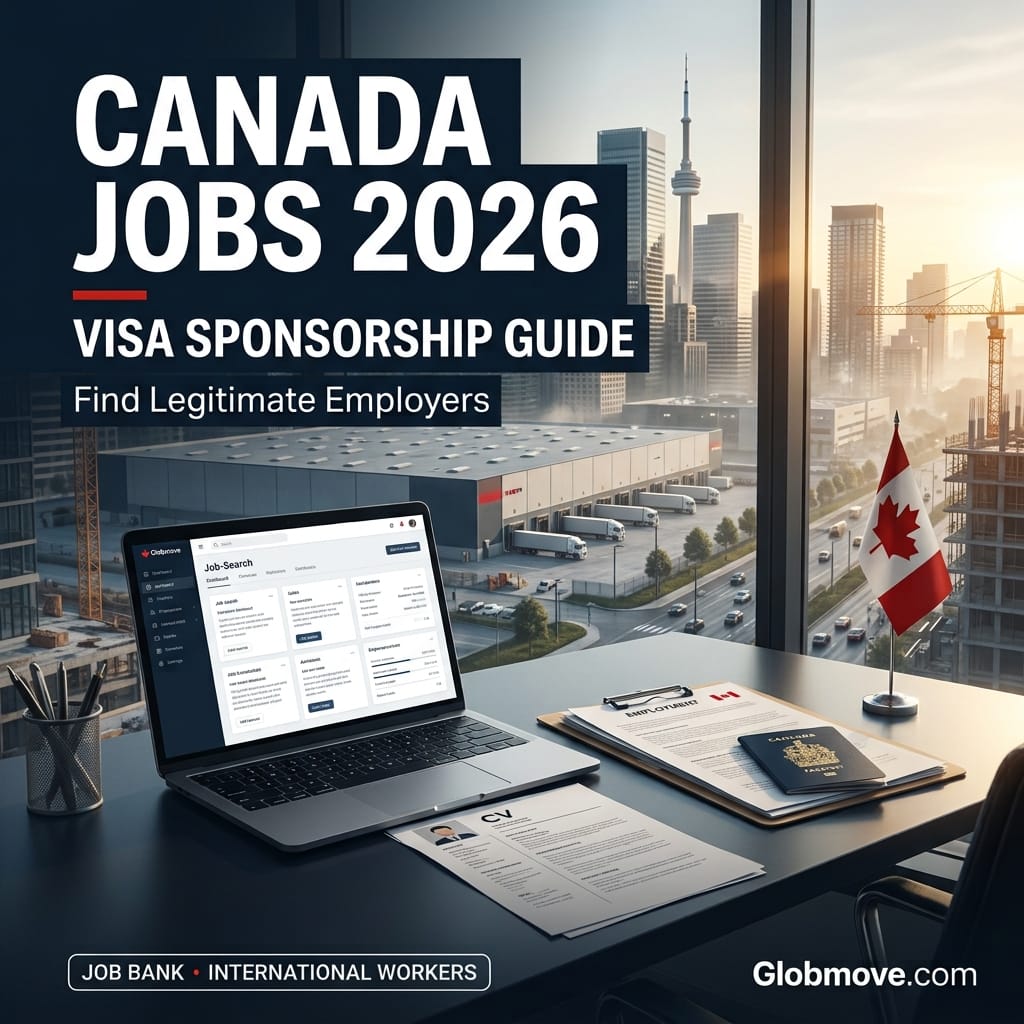
Job Bank Canada Visa Sponsorship Jobs 2026: How Foreign Workers Can Find Legitimate Canadian Employers
Canada remains one of the most searched destinations for people looking for visa sponsorship jobs abroad, but finding a genuine employer willing to recruit someone outside Canada is very different from simply searching Google for “Canada visa sponsorship jobs.”
One of the most useful places to start is Canada’s official Job Bank, operated by the Government of Canada. Unlike random job websites and social media pages advertising supposed sponsorship opportunities, Job Bank has a dedicated system for people outside Canada and identifies vacancies where employers are recruiting foreign candidates.
This makes Job Bank particularly useful for international workers searching for Canada jobs with visa sponsorship, including positions in agriculture, food service, trucking, construction, manufacturing, hospitality, caregiving, and other sectors.
But there is an important distinction that applicants need to understand.
Job Bank does not give you a visa simply because a vacancy appears on the website. Instead, it connects job seekers with Canadian employers. The immigration process comes afterward, and depending on the job and immigration route, the employer may need a Labor Market Impact Assessment (LMIA) before the worker can apply for an employer-specific work permit.
Understanding that difference can save applicants months of wasted applications and protect them from one of the biggest problems in international recruitment: fake sponsorship offers.
What Is Job Bank Canada?
Job Bank is Canada’s official employment service and provides a large database of vacancies across Canadian provinces and territories.
For international applicants, the most important feature is the dedicated Foreign Candidates section.
The platform specifically tells candidates outside Canada to look for employers recruiting international candidates rather than applying indiscriminately to every vacancy. Job Bank identifies postings intended for people who are already authorized to work in Canada separately from opportunities where employers are recruiting international candidates.
This is an important distinction.
If a job posting is available only to Canadian citizens, permanent residents, or people who already possess Canadian work authorization, an applicant sitting overseas should not assume that the employer will sponsor them.
Job Bank’s international-candidate system helps narrow the search.
Does Job Bank Actually Have Visa Sponsorship Jobs?
Yes, but the phrase “visa sponsorship” can be misleading.
Canada generally refers to work authorization through work permits, rather than simply using the terminology of visa sponsorship commonly used in other countries.
For many employer-specific work permits, the employer must take steps before the foreign worker can apply. In cases where an LMIA is required, the employer applies to demonstrate that there is a need to hire a foreign worker for the position.
Job Bank has a dedicated temporary foreign worker section where employers have already obtained or applied for an LMIA.
At the time of checking, Job Bank displayed thousands of vacancies through its temporary foreign worker search. The database included jobs ranging from farm workers and food-service positions to truck driving, construction, warehouse and supervisory roles. The number changes constantly as vacancies are added, filled, withdrawn, or expire.
This is why applicants should search the live database rather than rely on screenshots or lists of supposedly available jobs posted months ago.
The Most Important Job Bank Filter for International Applicants
One of the biggest mistakes applicants make is typing a job title into Job Bank and applying to everything that appears.
That approach can waste enormous amounts of time.
When searching from outside Canada, look for vacancies specifically identified as being available to international candidates.
Job Bank explains that postings can indicate whether they are open to people outside Canada. It also distinguishes between jobs intended for Canadians and authorized workers and jobs where Canadian employers are seeking international candidates.
This is arguably more useful than searching for the words “visa sponsorship.”
A job may not literally say visa sponsorship in its title but could still be connected to the temporary foreign worker system.
Likewise, a vacancy may mention LMIA without guaranteeing that an applicant overseas will receive a work permit.
What Does “LMIA Requested” Mean?
This is one of the most important terms to understand before applying.
LMIA stands for Labor Market Impact Assessment.
In general, an LMIA is used to assess whether hiring a temporary foreign worker is necessary and what impact that hiring would have on Canada’s labor market.
If an employer has submitted an LMIA application but has not received a decision, Job Bank may show the vacancy as “LMIA requested.” If the employer has already received a positive LMIA, the vacancy can be marked “LMIA approved.”
These statuses should not be treated as identical.
LMIA Requested
The employer has asked for authorization to hire a foreign worker, but the process is not necessarily complete.
LMIA Approved
The employer has received approval to hire a foreign worker for the relevant position.
An approved LMIA can therefore be a stronger signal than simply seeing “LMIA requested,” although the worker still has to satisfy Canada’s work-permit requirements.
Job Bank itself warns applicants that an LMIA-related job posting does not mean the applicant automatically has Canadian work authorization.
What Jobs Can International Workers Find on Job Bank?
The available occupations change frequently, but Job Bank’s temporary foreign worker listings can include both skilled and lower-skilled positions.
Some categories worth monitoring include:
Agriculture and Farm Work
Agriculture is one of the sectors where Canada’s temporary foreign worker system has long played an important role.
Search terms can include:
- Farm worker
- General farm worker
- Harvesting worker
- Greenhouse worker
- Agricultural laborer
- Livestock worker
These jobs can be particularly relevant to applicants without advanced academic qualifications.
Truck Driving and Transportation
Commercial driving positions can appear regularly, although applicants must satisfy the relevant licensing requirements.
A foreign driver’s license does not automatically qualify someone to operate a commercial vehicle in Canada.
Food Service and Hospitality
International candidates may encounter vacancies such as:
- Cooks
- Food service supervisors
- Kitchen helpers
- Restaurant workers
- Hotel-related positions
However, applicants should carefully read each vacancy because employers can specify experience, language, certification, and other requirements.
Construction and Trades
Job Bank can also contain positions connected to construction and skilled trades.
Applicants should not assume that because a job is described as labor-intensive, no qualifications are necessary. Many Canadian trades are regulated or require specific certifications.
Manufacturing and Production
Production, processing, packaging and factory-related vacancies can also appear in the temporary foreign worker database.
The important point is that “no university degree” does not mean “no requirements.”
How to Search Job Bank From Outside Canada
The process is relatively straightforward, but the way you search matters.
Start with the official Job Bank foreign-candidate section rather than a third-party website.
Then:
Step 1: Identify your occupation
Search for the actual job you can realistically perform.
Instead of searching only for “visa sponsorship,” try terms such as:
- farm worker
- cook
- warehouse worker
- truck driver
- food service worker
- general laborer
- agricultural worker
- production worker
Step 2: Check the location
Canada is a large country, and employers outside major cities may have very different recruitment needs.
Do not restrict yourself to Toronto or Vancouver simply because they are the most internationally recognized Canadian cities.
Step 3: Check whether international candidates are accepted
This is critical.
A vacancy intended only for Canadians, permanent residents and people who already hold work authorization is generally not the right target for someone applying from overseas.
Step 4: Examine the LMIA information
If applicable, check whether the employer has requested or obtained an LMIA.
Step 5: Read the entire vacancy
Do not apply based only on the title.
Read the requirements, wage, location, employment duration, language requirements, experience requirements and application instructions.
Why Applying to 100 Jobs May Still Produce Nothing
International applicants often believe success is simply a numbers game.
They submit dozens or even hundreds of applications and become frustrated when nobody responds.
But Canadian employers have a reason to be selective.
If an employer is going through the process of recruiting internationally, there may be additional administrative requirements compared with hiring someone already authorized to work in Canada.
That means an applicant needs to make the hiring decision easy.
A strong application should immediately communicate:
Who you are → what experience you have → what position you are applying for → where you currently live → whether you require work authorization → why your experience matches the vacancy.
Job Bank itself recommends that foreign candidates include information such as their location, work experience and whether they already have a valid Canadian work permit when applying.
Your CV Matters More Than You Think
For international applications, your CV should be simple and highly relevant.
Do not send a five-page biography if the vacancy is for a farm worker.
If you are applying for a warehouse position, highlight warehouse, inventory, packing, loading, safety and physical-work experience before unrelated academic achievements.
If you are applying for hospitality work, put customer service, food preparation, housekeeping, hotel, restaurant or service experience near the top.
The objective is not to make your CV look impressive in general.
It is to make the employer think: “This person can actually do this job.”
That is a much more useful objective.
Do You Need to Pay for LMIA Sponsorship?
This is an area where international applicants need to be extremely careful.
Do not pay an individual who claims they can sell you an LMIA or guarantee a Canadian job.
Job Bank states that employers should not ask workers to pay them to hire them, and its temporary foreign worker guidance also states that employers are not allowed to make workers pay for the LMIA.
A recruiter saying:
“Pay me $5,000 and I will give you an approved LMIA.” should be treated as a major warning sign.
A legitimate Canadian recruitment process does not work like purchasing a visa.
Job Offer First, Work Permit Second
This is another area where social media creates confusion.
If you are outside Canada and pursuing an employer-specific work permit, obtaining a genuine job offer is only one part of the process.
Depending on the position, the employer may need an LMIA or the position may qualify for an LMIA-exempt route.
Canada’s official guidance explains that an employer-specific work permit requires a job offer from an eligible employer and that, for most jobs requiring an LMIA, the employer must complete that process before the worker applies.
Therefore, the realistic sequence may look like:
Find eligible employer → apply → interview → receive genuine offer → employer completes required immigration steps → receive required documentation → apply for work permit → wait for decision → travel after authorization.
Do not confuse a job advertisement with a work permit.
A Job Bank Vacancy Does Not Guarantee a Visa
This deserves its own section because it is one of the most important warnings for readers.
Even if you find an LMIA-related vacancy, several things can still happen.
The employer may:
- Select another candidate.
- Withdraw the position.
- Have an LMIA application refused.
- Decide not to proceed with international recruitment.
- Require qualifications you do not have.
- Discover that the position is no longer available.
And even after an employer completes its part, the worker must satisfy Canada’s immigration requirements.
The safest way to think about Job Bank is:
It is a legitimate place to find potential employers—not a website that guarantees visas.
How to Make Your Application More Competitive
Instead of applying randomly, create a targeted strategy.
Choose two or three occupation categories that genuinely match your experience.
For example, someone with restaurant experience could focus on:
Cook + kitchen helper + food service positions.
Someone with agricultural experience could focus on:
Farm worker + greenhouse worker + harvesting positions.
Someone with logistics experience could focus on:
Warehouse + shipping/receiving + inventory positions.
This makes it much easier to tailor your CV and application.
It also prevents your profile from looking inconsistent.
What If You Don’t Have Any Canadian Experience?
That is not automatically a problem.
Job Bank’s foreign-candidate system exists specifically to help international candidates find employers recruiting outside Canada.
However, you need to compensate for the lack of Canadian experience by showing transferable experience.
For example:
Someone who worked in an Ethiopian warehouse can demonstrate inventory handling, order preparation, stock control and workplace safety.
Someone who worked in a hotel can demonstrate housekeeping, guest service and teamwork.
Someone who worked on a farm can demonstrate harvesting, crop handling, machinery assistance and physical work.
The employer needs evidence that you can perform the job—not necessarily evidence that you have previously worked in Canada.
Why Smaller Canadian Communities Can Be Worth Considering
Many applicants search only for Toronto, Vancouver, Montreal or Calgary.
That creates enormous competition.
Some employers in smaller communities face different recruitment challenges and may have stronger reasons to consider international workers.
Agricultural areas, rural communities, smaller manufacturing centers, tourism destinations and regional employers can therefore be worth exploring.
This does not mean every rural vacancy offers sponsorship.
It means international applicants should not automatically eliminate smaller communities from their search.
Job Bank vs Random “Canada Sponsorship” Websites
There is an enormous difference between the two.
A random website may advertise:
“Canada visa sponsorship jobs — $50/hour — no experience required — guaranteed visa.”
That headline may generate clicks, but it tells you almost nothing about whether the employer is legitimate.
Job Bank provides employer information, job descriptions, wages, locations, application instructions and immigration-related indicators.
It is therefore a much stronger starting point.
For applicants outside Canada, official sources should always be the first layer of research.
Final Thoughts
Job Bank Canada is one of the most useful legitimate resources for international workers searching for Canadian employment, particularly because the platform provides dedicated information for foreign candidates and a separate temporary foreign worker job search.
But applicants should understand what the platform does and does not do.
It does not sell visas. It does not guarantee sponsorship.
And seeing the words “LMIA requested” does not automatically mean that you will receive a Canadian work permit.
What Job Bank does provide is something much more valuable: a direct route to legitimate Canadian employers who may be recruiting internationally.
The strongest strategy is therefore to identify jobs that genuinely match your experience, use the international-candidate filters, investigate the employer, tailor your CV, apply carefully, and understand the immigration process before accepting an offer.
For anyone searching for Canada visa sponsorship jobs in 2026, this approach is considerably safer and more realistic than paying an agent for a supposed guaranteed job.